Reading time20’

Rose is Not Rose

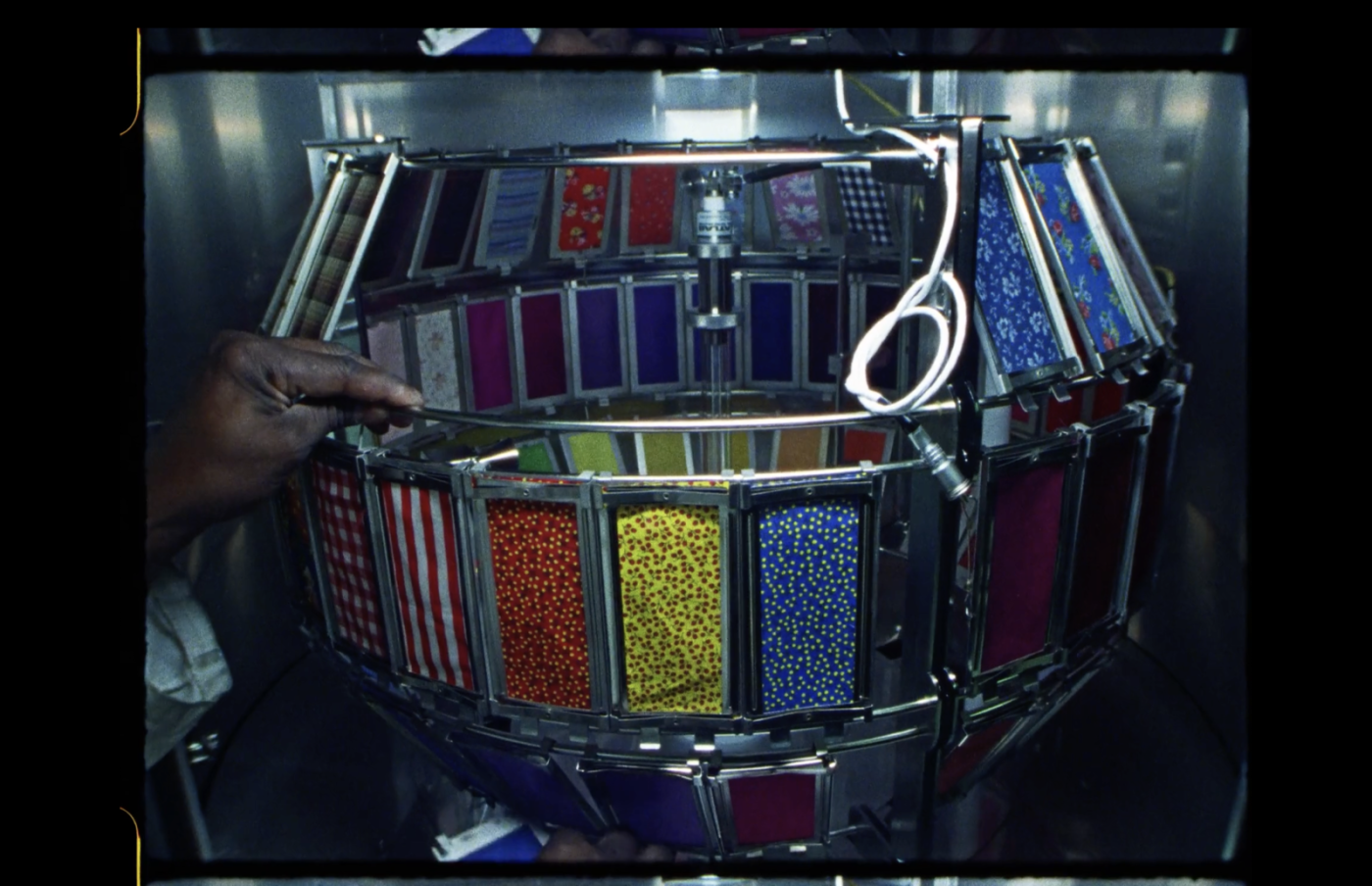
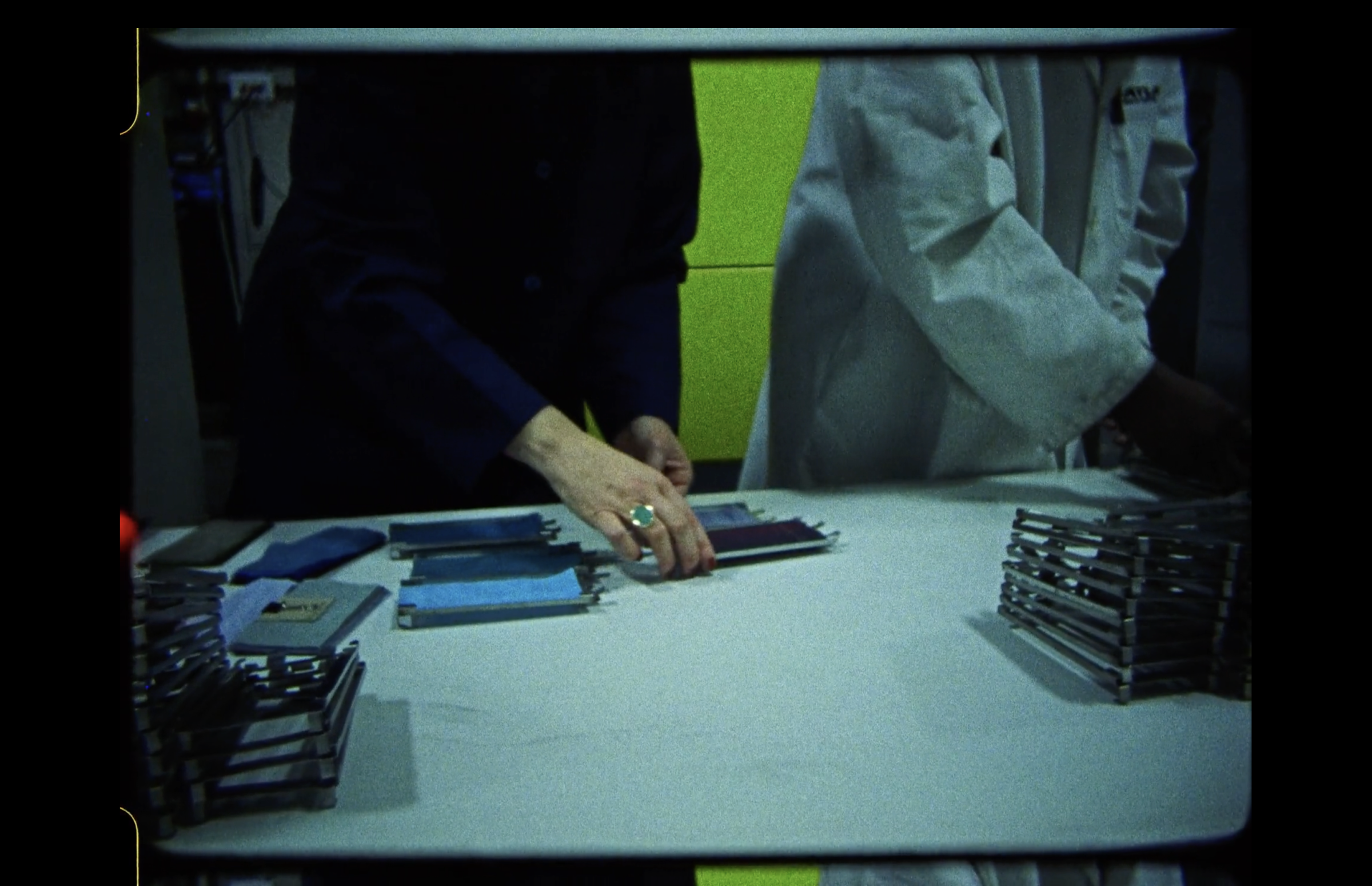
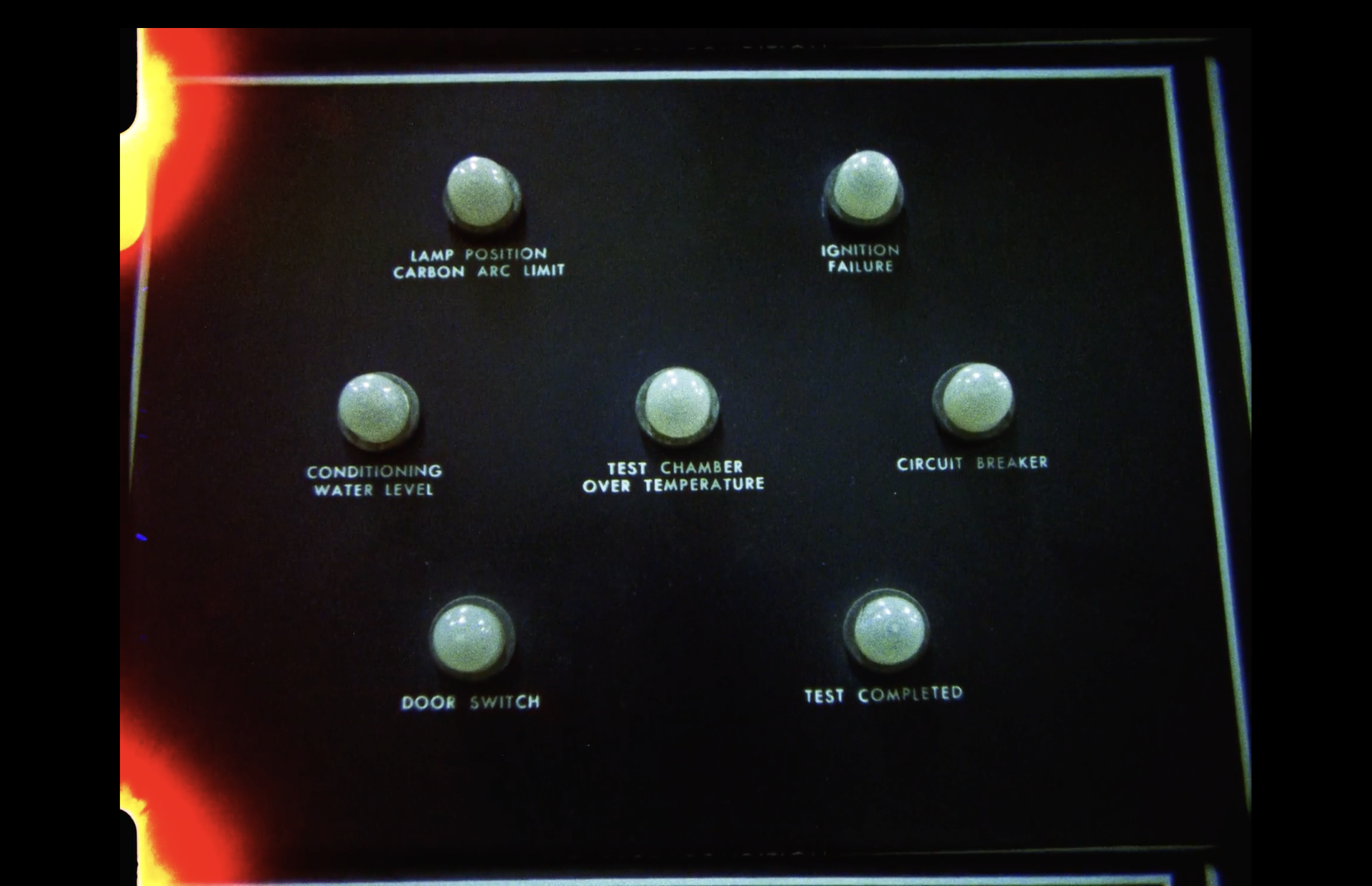
Yto Barrada, <i>The Power of Two or Three Suns</i>, 2020. 16mm transferred to digital video, sound, color 11 minutes, 11.0 seconds. © Yto Barrada, courtesy Pace Gallery; Sfeir-Semler Gallery, Hamburg, Beirut; and Galerie Polaris, Paris.
Yto Barrada, The Power of Two or Three Suns, 2020. 16mm transferred to digital video, sound, color 11 minutes, 11.0 seconds. © Yto Barrada, courtesy Pace Gallery; Sfeir-Semler Gallery, Hamburg, Beirut; and Galerie Polaris, Paris.

Yto Barrada and Yasmine Seale, September 2025

An art of salvage is also one of resistance and survival (...)

I was in Tunis, waking from a nap, when Yto Barrada called. You’re near Carthage, she said. You should go and meet the man who makes purple from sea snails. Barrada doesn’t spell things out; she doesn’t need to. Her phrasing, like her art, is allusive and economical, glinting with expressive power. She sent me his name, and within minutes I was exchanging messages with Mohammed Ghassen Nouira, a Tunisian consultant who has spent years reviving the technique of making purplish red dye, one of the most mysterious and precious colours of the ancient world, from the mucous glands of shellfish he finds on the shore. Within hours I was sitting in his garden, handling swatches of velvet and silk he had tinted the same colour as the sails on Cleopatra’s boat. 

Nothing is wasted. Sea snails are a by-catch, Nouira explained: they get tangled in fishermen’s nets and he simply goes to the port and collects them. Every part of the animal is put to use: besides the gland that produces the dye, he fries up the flesh for food; the shells he dries out in a pottery kiln and crushes to make lime; the operculum is mixed with incense to draw out its scent, a technique that goes back to antiquity; and with the guts he makes a garum that smells uncannily like soy sauce. 

This encounter, though it occurred thousands of miles from Barrada and was prompted by a throwaway remark of hers, seemed to bear her imprint. The marriage of science and imagination, the loving recovery of vernacular knowledge, the project to derive ornament and sustenance from local life-forms echo Barrada’s longstanding interest in natural colours, resulting in the creation of a dye garden in her hometown of Tangier, another port city on the northern tip of Africa. Throwaways—things intended to be discarded after brief use—are her mode, her meat. An art of salvage is also one of resistance and survival: doing the most with the least. 

“I have a problem,” Barrada says when I visit her studio in Brooklyn a few weeks later. “I can’t bear to throw things away.” She is showing me a stretch of fabric she has dyed pale pink with cochineal, a pigment made from the pulverised bodies of a cactus-eating insect native to the Americas. Its deepest hue is a red so brilliant that in the seventeenth century, cochineal was Mexico’s most valuable export after silver. But why stop at brilliance? Used and reused, the same dye bath will produce all the gradations of sunrise, from hot plum to the softest cotton candy. “I love the idea of exhausting a vat. The dyeing vocabulary is to die for…” To make a colour less bright, she says with pleasure, is to sadden it. 

It’s typical of Barrada, ever alert to language and its tricks, to have picked up on the emotive undercurrent running beneath the dyer’s argot like a blush under glassy skin. Lingering on the idea of exhaustion—the technical term for the proportion of dye absorbed by the fibre—extends her enduring concern with labour and its discontents, with the human cost of what another kind of thinker would call by large, unlovely names: capitalism, globalisation. A cold name for a cold thing, perhaps. But the swerve away from abstraction is a choice for Barrada, who started out as a student of political theory. One of her great insights is that vast systems are always embodied in this person and this place, irreducibly specific and strange, and that for every depredation there is deviance and subterfuge—loose ends of our interwoven globe. (“The grandiloquent always rubs me up wrong,” she once confessed in an interview. “You can say so much more with a bucket of mussels and a camel.”1

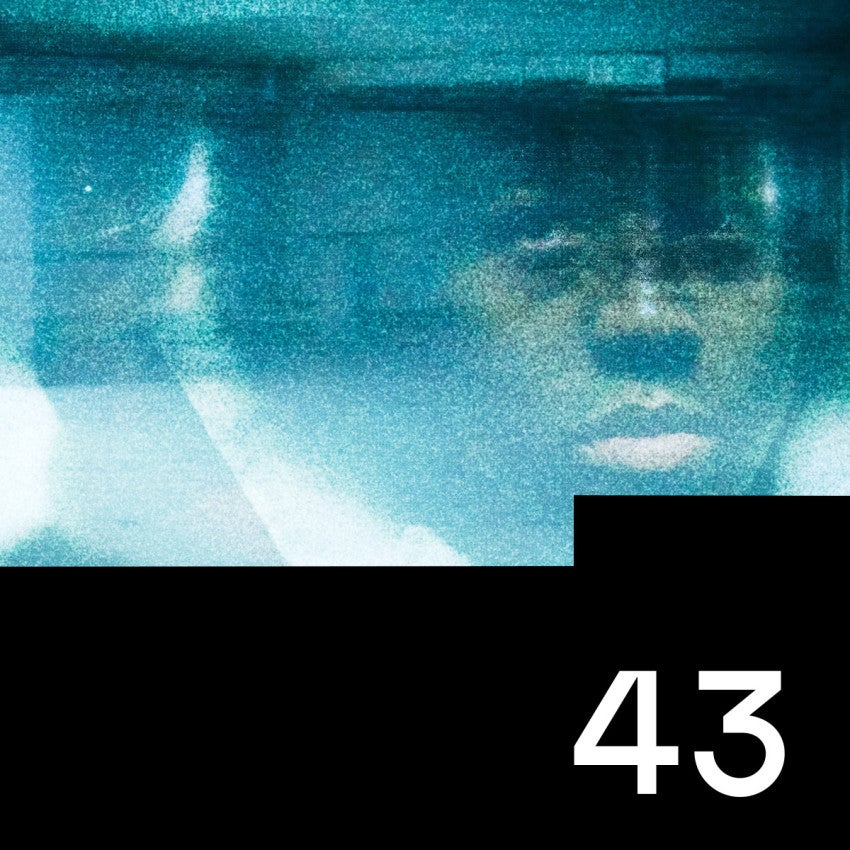
Through her eyes, the infrastructure of modern life becomes a fount of surreal, even sensuous detail. The Power of Two or Three Suns (2020), a short 16mm film, takes us into a lab that tests the durability of textiles by simulating the passage of time through “weather acceleration” and other godlike procedures. Faceless bodies in uniform manipulate fabric samples, pressing them into metal frames. (Barrada likes to zero in on hands, as if in homage to craftsmanship and its anonymous practitioners.) The frames are then clamped to the sides of a spherical chamber until the whole structure is wallpapered with strips of colour like a giant patchwork egg. The egg starts to revolve; at its center is a shining rod of xenon, the same gas used to power cinema projectors, which exaggerates the effects of sunlight (hence the film’s title) and fast-forwards the textiles into old age. There is a poignant contrast between these industrial materials, designed to withstand extreme conditions and perhaps to survive the end of the world itself, and the vulnerability of the workers who produce them. None of this, of course, is spelled out. The film is speechless, but it is not silent. Its soundtrack is the eerie song of the machines, an alien whine that rises to something almost mystical as the lights go down and the fake green sun glows. We might be watching some occult ritual, a caravan of colours circling a neon aleph.

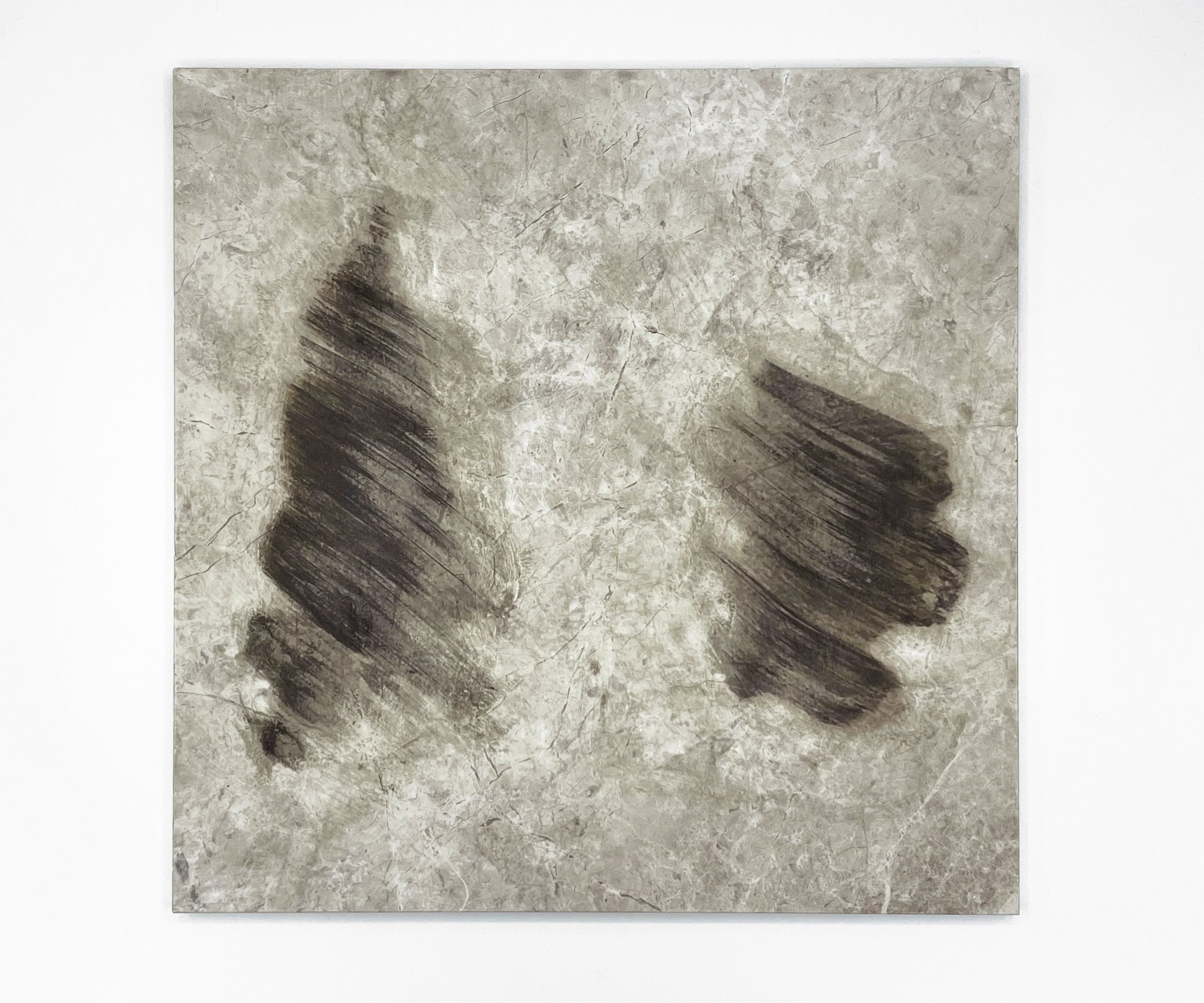
“I was interested in decay and ways of measuring it,” Barrada tells me. Around us, decades of work are being decanted into boxes. The studio is in flux. In three days it will be empty; Barrada and her family are moving to Paris. She punctuates our conversation by dipping into drawers and open crates, summoning past projects: show-and-tell at the lost-and-found. On the subject of deterioration, she lifts up a square of marble, a work she made for a show in Japan. Its chalky surface is imprinted with two vague, charcoal-coloured forms. They look like smokers’ lungs, or clouds before a storm: the artist at her most abstract and austere. In fact, these Scuff Marks (2022) are a documentary image, a record of shoeprints found on the freshly painted kasbah in Tangier. They were left there by hittistes, a North African term for unemployed young men who lean against walls (hit in Arabic) as if their job were to hold them up. She photographed the traces of their loitering and transferred the results onto the limestone slabs, giving these marks of urban dispossession a poetic, noble quality. 

(...) she is attentive to the scars and voids left behind when something disappears.

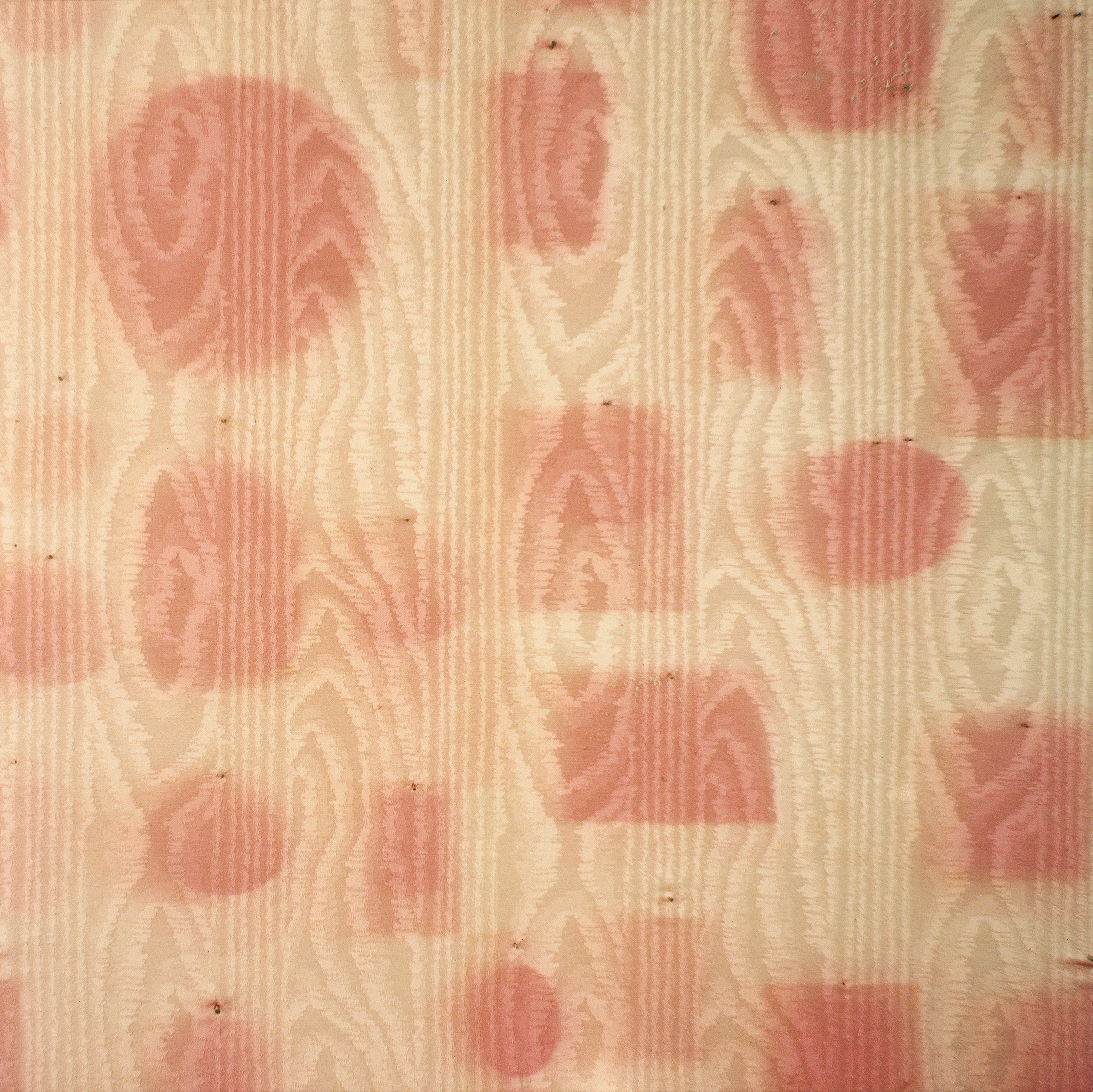
Barrada is not nostalgic, but she is attentive to the scars and voids left behind when something disappears, the shape its absence makes. One of my favourite photographs of hers is Family Tree (2005), a similar blend of realism and abstraction. What appears to be a lattice of pure colours and shapes, one pattern laid over another, soon resolves into narrative. We are looking at a patch of wall on which portraits must have once hung. Now all we see are the outlines of their frames, some rectangular and some round, which have stained the wall a dusty rose. The wall itself is decorated with the grain of the tree it once was, a peacock’s tail of pinewood. (In fact, what I took to be wood turns out to be a stretch of silk damask: one natural material artfully worked to look like another.)  As often with Barrada, a kind of double vision is at work. Enormous questions—about kinship and transmission and memory, about the relationship of people to place, of culture to nature—are raised then punctured by the image’s elegance and subtlety. The longer you look, the longer it looks back. 

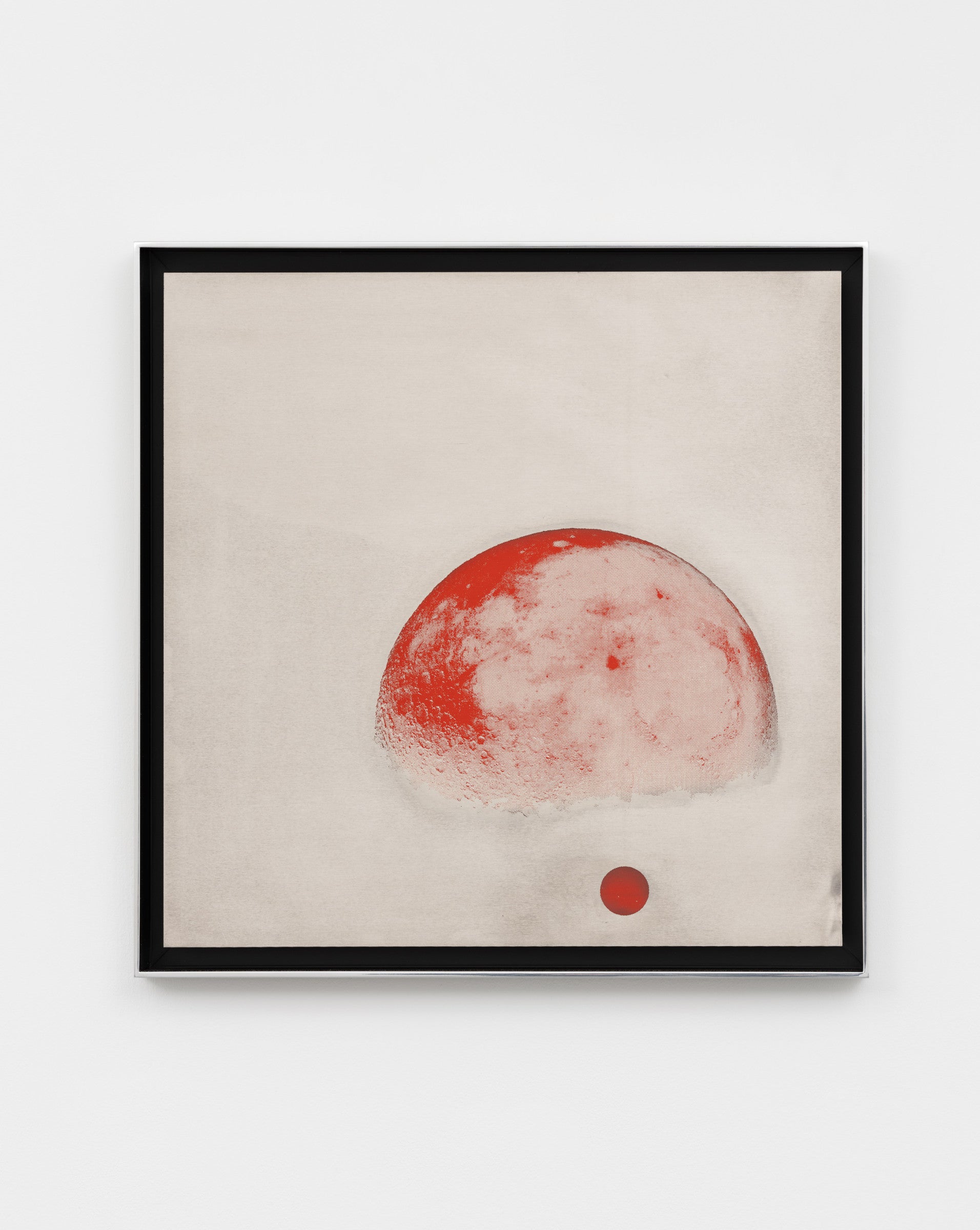
Omar Khayyam catches my eye. His name in Arabic and English draws me to a corner of the studio, where a poster is rolled up. A project for the façade of an art school in Cergy, outside Paris. This was in 2020, when statues were coming down and names were being contested. Barrada’s response was to think about the history of naming in outer space, and to produce a map of the twenty-five lunar craters named after Arab or Muslim scientists. “You know there’s no erosion on the moon,” she says, “so a hole is a hole forever.” As the Arab contribution to knowledge is forgotten or erased here on earth, and the “giant leap for mankind” is claimed for the West, it is good to think of these craters—the opposite of a statue—as unfading monuments to that neglected history. The moon, after all, is Earth’s Orient: our bewitching other. I am reminded of Enceladus, one of Saturn’s icy moons, whose features were all given the names of characters and places in The Thousand and One Nights, because its surface is considered so mysterious (there is a salty sea under the ice, suggesting this world might have the right conditions for life). A humanoid hollow is called Shahrazad. Fissures along the southern hemisphere, known as “tiger stripes,” are called Baghdad, Alexandria, Damascus. 

Between us on the table, between the painter’s tape and the bundles of dyed cotton, is a box of macarons. Their simple round shapes and primary hues make them look like a maquette for one of Barrada’s public sculptures. I wonder if these confections, which I associate with Marie-Antoinette, are a gesture toward the eighteenth century, whose colour theories she is currently researching. Are we eating the Enlightenment? (Barrada has described her approach to historical material as “carnivorous”: chewing the archive and spitting it out.2) Later, I learn that the sweet has an Arab origin. A Swiss encyclopaedia says they were brought from Al-Andalus to Morocco in the eleventh century, before moving up through Sicily to Venice, where they became maccaroni. Time spent in Barrada’s universe produces a delicious reorienting, as if the shores of the Mediterranean had been brought closer together (north and south almost kiss in Tangier) or had been flipped ninety degrees to lie face to face. 

.

To go back to ABCs is (...) to ask how we might do things differently if we could start again.

I visited Barrada’s studio in the eighth month of my pregnancy, began writing this essay in the ninth, and finished it while breastfeeding my daughter. This felt apt: there is a strong connection between her practice, the work of mothering, and the way children play. We looked at many wonderful things during our hours together, of which the most wonderful was a book she described as one of her treasures: an art album that had belonged to a small child around the year 1900. The book contains a year’s worth of exercises, or “gifts” in the terminology of Froebel, the nineteenth-century inventor of the kindergarten. He wanted children to go beyond rote learning and developed a method based on the physical manipulation of objects. Educational toys, inspired by the geometric forms of crystals, were to be given in a particular order to teach lessons about structure and perception: knitted balls, wooden cubes, and so on. Frank Lloyd Wright credited his exposure to Froebel’s games as a child with his interest in the principles of design. Buckminster Fuller, introduced to the same ideas, discovered the geodesic dome in kindergarten.3 The album Barrada owns is devoted to folded paper constructions, growing more intricate over time. They show an instinctive understanding of modernist aesthetics in their five-year-old maker. Mouths open, we watch the history of art unfold. “You see Ellsworth Kelly, you see [Josef] Albers…” She turns a page. “Hello, Bauhaus.” 

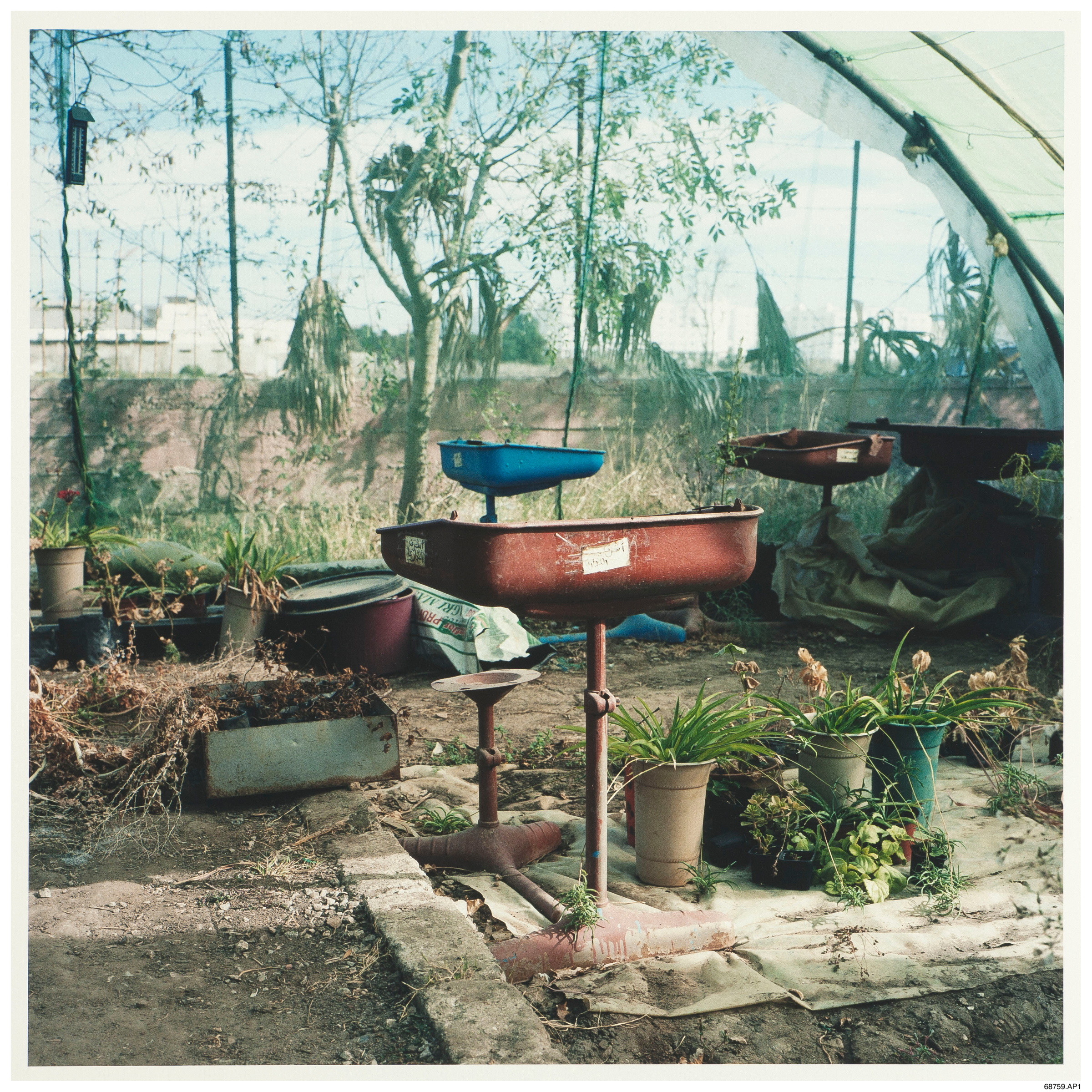
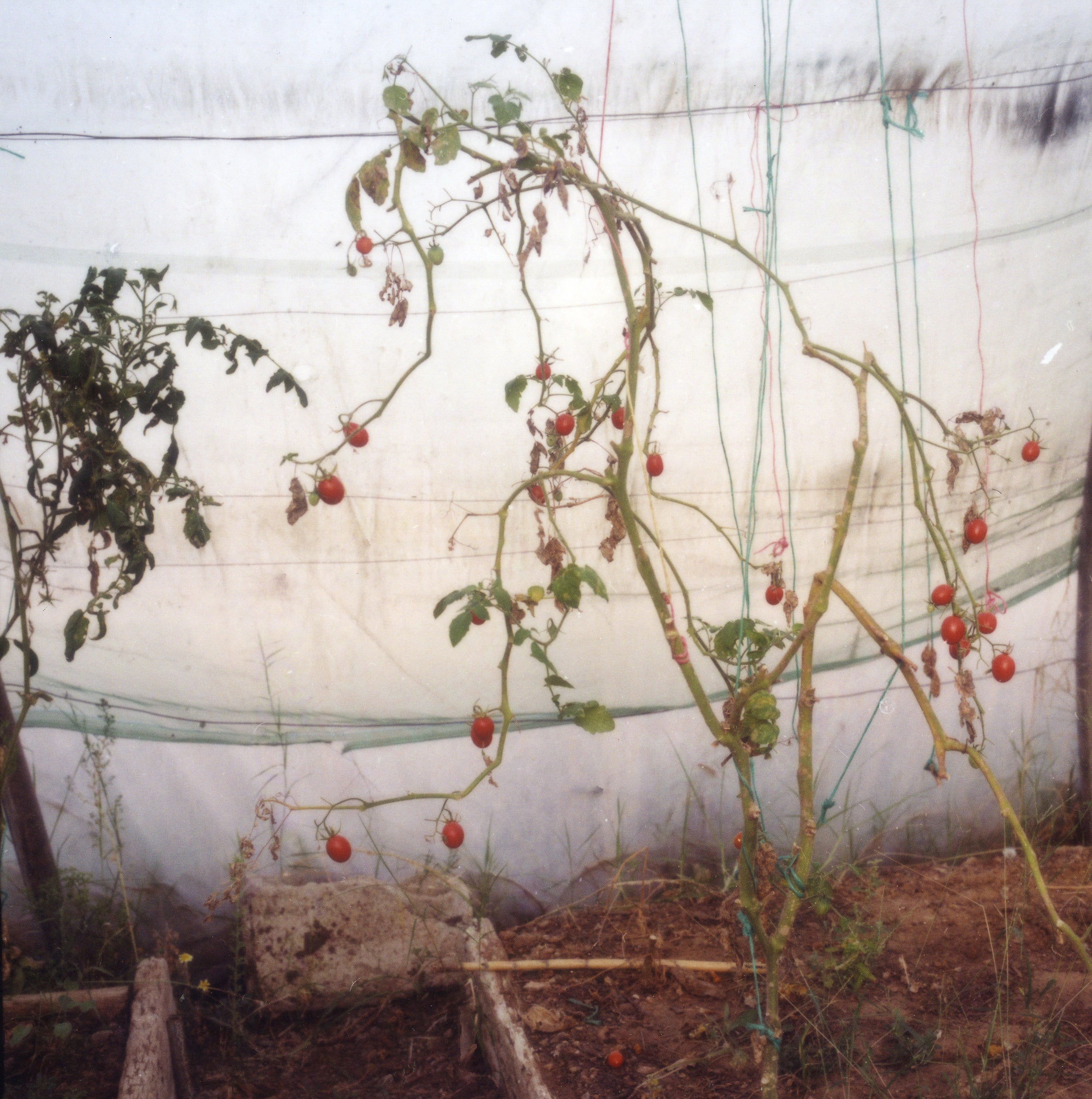
The book was a glimpse into Barrada’s marvellous collection of educational manuals. Another gem I spotted: How to Write Better Business Letters, written by an Egyptian husband and wife and featuring a template in three languages for how to sell a kilim. Many of her own works adopt (and subvert) pedagogical forms: tutorials, samplers, maps. Like the playgrounds and vacant lots that recur in her images, these how-tos carve out utopian spaces of possibility. To go back to ABCs is to reconsider the very building blocks of our mental and social lives, to ask how we might do things differently if we could start again. It is also to question who is learning from whom. Ferme pédagogique, a series of photographs by Barrada from 2011, includes an image of a loose-limbed tomato plant, offering its ruby fruit beyond the boundary of its little plot. If this is a teaching farm, what does it teach? Froebel thought children should be nourished “like plants in a garden.”4 But are we to take our cues from the plant’s straggly exuberance, or from the lengths of rope and wood trying to keep it erect? As Bee Wilson writes of Maria Montessori, another source of inspiration, who developed her own ideas a hundred years later: “The radical idea at the heart of [her] method was not that children learn by play but that adults prevent them from learning by interrupting them.”5 

Taking young people seriously as natural experimenters and world-builders aligns with Barrada’s other commitments, her tender regard for forgers, smugglers, saboteurs, acrobats, autodidacts, informal economies, black humour, wildflowers, hand-me-downs—a whole agile collective curved around and against the world’s structures of exclusion and control. “La débrouillardise humaine”—an earthy combination of resilience and street smarts—is what interests her. (Barrada’s conversation drifts easily across four languages; ours took place mainly in French.) On a podcast, when asked to define herself in a song, she offered “La Mauvaise Herbe” by Georges Brassens (1954), whose title translates to weeds. A grammar of soft subversion, much of her practice resists the view that frames wildness and border-crossing as undesirable. I think of the phrase invasive species. I think of Athens, where I once saw an old yiayia pull a large clump of leaves from a crack in the pavement and pocket it, later to be boiled and dressed with oil and lemon. The insect that produces cochineal lives and feasts on the pads of the prickly pear, its spiky host. One person’s parasite is another’s livelihood. Weeds are in the eye of the beholder. 

.

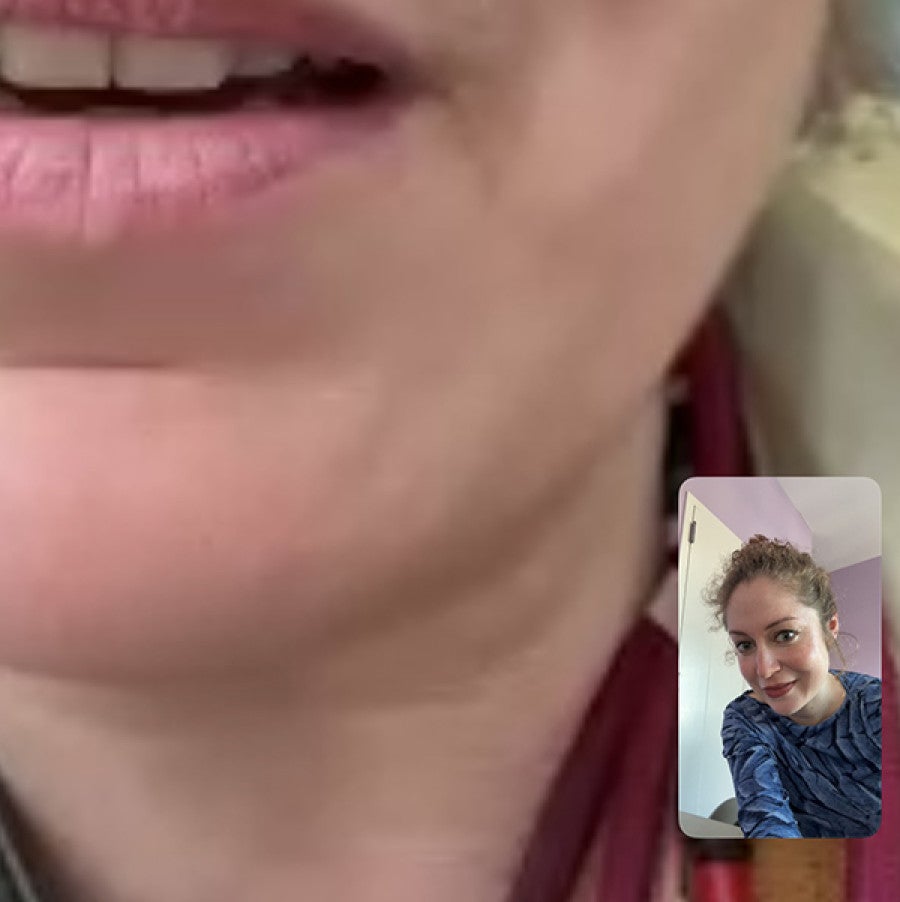
Late in the summer, after Barrada and her family have moved across the ocean, I video call her from New York. She picks up the phone in the marché Saint-Pierre, a world of fabric shops at the foot of Montmartre, where she is choosing cushions, making plans with her assistant, and simultaneously telling me about her research into devoré, a velvet-dissolving technique also known as burnout. (As Andrea Andersson, a curator and close collaborator of Barrada’s, put it when we spoke: “So many layers of exchange are happening and only some of them are with me.”) In the taxi, she pauses to point out the Louxor, one of the oldest cinemas in Paris, an Art Deco palace inspired by the Valley of the Kings. Our talk turns back to colour. I say I’ve been reading about Van Gogh, how he loved to use fugitive pigments even if it meant the colours would fade fast. “All the colours that Impressionism has made fashionable are unstable,” he complained to his brother Theo, all the more reason boldly to use them too raw, time will only soften them too much.”6 He gave his mother a painting of red roses, which by the time he died had turned a whitish pink. Yto laughs. “I like the embedded destruction in the object… A self-destructive colour. Also the idea of the unstable being valued.” The French word for a colour chart is nuancier: a nuance device. To think about colour is also to tease out shades of meaning, to train one’s eye on ceaseless change and fine distinctions. Things are more complex and precise than their names. Rose is not rose is not rose.

Interview with Sina Najafi, in Yto Barrada, eds. Lionel Bovier and Clément Dirié (Geneva: JRP|Editions, 2013).

Tate, “Enter the Mothership: artist Yto Barrada’s Tangier garden,” video, YouTube, 5:40, posted 29 May 2024, https://www.youtube.com/watch?v=a-DWf-3CYoo.

Kurt Kohlstedt, “Inheriting Froebel’s Gifts”, 99% Invisible, podcast, episode 492, 24 May 2022, https://99percentinvisible.org/episode/inheriting-froebels-gifts/.

Ibid.

Bee Wilson, “Like a Bar of Soap,” London Review of Books 44, 24 (15 December 2022),  https://www.lrb.co.uk/the-paper/v44/n24/bee-wilson/like-a-bar-of-soap

Vincent Van Gogh to Theo Van Gogh, 11 April 1888, in Vincent van Gogh: The Letters, ed. Leo Jansen, Hans Luijten, and Nienke Bakker, vol. 4 (London: Thames & Hudson, 2009), letter 595. Accessed at Van Gogh Letters Project, https://vangoghletters.org/vg/letters/let595/letter.html

Read more essays