What could be easier than to write articles and to buy Persian cats with the profits? But wait a moment.1
—Virginia Woolf
The kitchen in the image is, of course, beautiful. It is modern, neat, bright, and fitted with every contemporary appliance of the times. Light streams in from large windows, catching on a shining white porcelain coffee cup left on the breakfast bar. It must be late morning. There are well-placed houseplants and a fresh bouquet of tulips on the counter in a glass vase. There is a woman, a mother, standing at the kitchen sink. She is reaching forward, towards the tap for something but looks back, behind her, at a child, who is sat on the floor, playing with a dog. The woman is wearing a white shirt and a pencil skirt, and high-heeled strappy sandals. But wait a moment. Those are evening shoes. And what’s more, her back foot is very precisely pointed, like a professional dancer’s, a strange detail that tugs at the coherence of the image. The woman smiles a bright white smile in the direction of the child, yet they seem to regard one another, estranged. Are you my mother? No, she is not. She has the bearing of an actress, a performer. The two of them are frozen in place. And now we can perceive that they have been posing in the same position for too long, the toe pointed just so, the twisted position and the bleached smile aching. It is a little cold, this emptiness that is suddenly there. Something has gone missing, a message has become unmoored, some funny dialogue that was supposed to provide relief has gone unspoken, some bigger problem has now gone unsolved.
This image, titled Maisons Françaises, une collection n°MJ198305P163 (2025) features in an ongoing series by the artist Laëtitia Badaut Haussmann, in which she extracts images from vintage copies of French interiors magazines, including Maison Française. As an artist, Badaut Haussmann has an interdisciplinary practice which often spills into discursive endeavors and the creation of extensive archives, though her most enduring preoccupations circulate expressions of gender, sexuality and socio-cultural norms in architecture and design. When she acquired her late-grandmother’s collection of magazines from the 1970s and 80s, she moved them into her studio, where she slowly began to review their contents, treating them as a kind of evidence of para-architectural material mostly targeted at women (though its readership would have certainly included a substantial contingent of gay men and queer people, and other readers). As ‘evidence’, however, Baudaut Haussmann found that what was contained in the magazine ads was often surprisingly surreal, threatening, and strange, and what began to reveal itself to her was a picture of a shadowy, circumscribed zone of feminine existence.
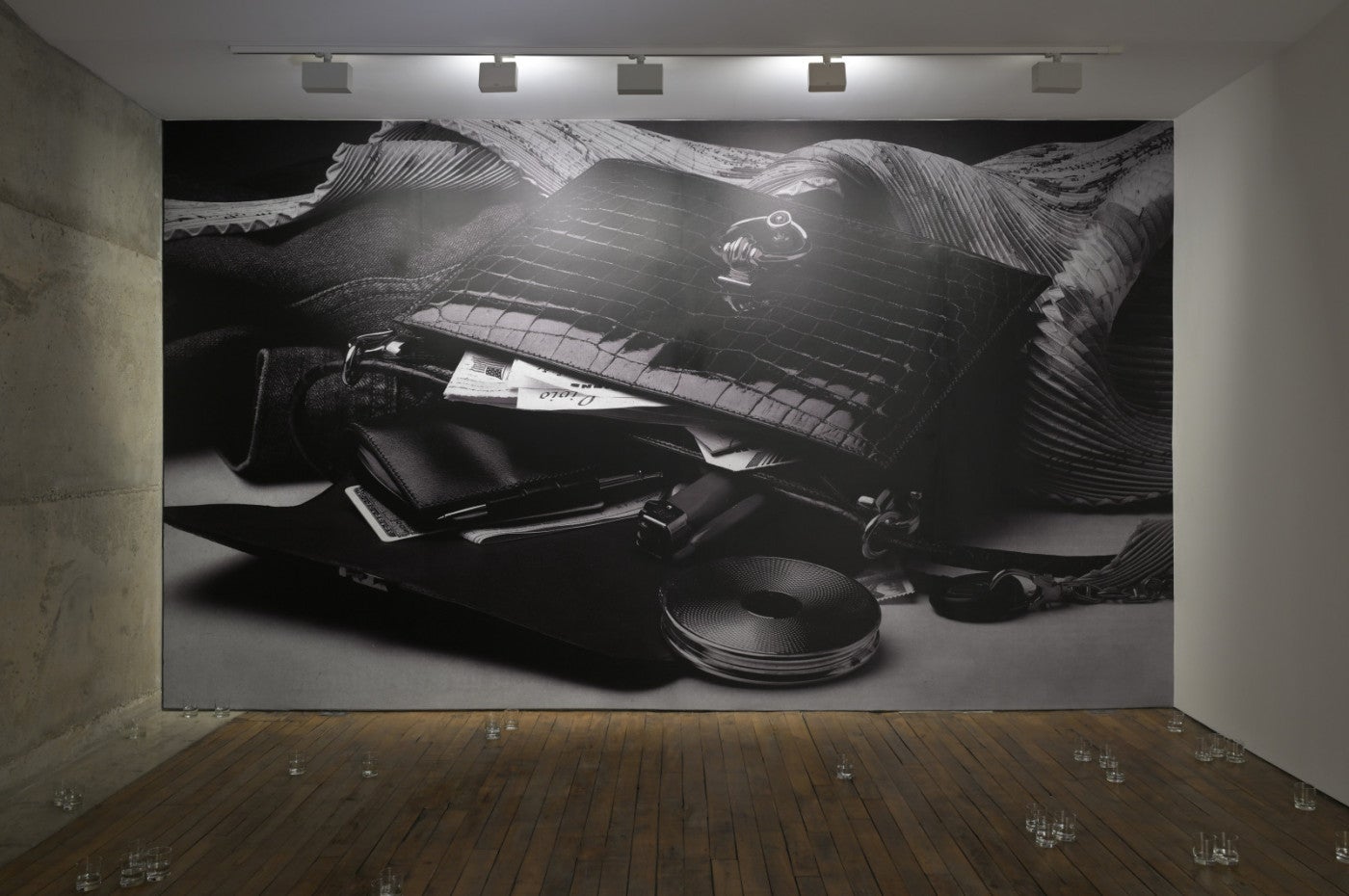
To draw out the subtexts of her material, Badaut Haussmann scanned a number of original advertisements and digitally removed all of the text and graphic design work, leaving only the image. She then subjected each picture to a unifying grayscale treatment, giving the images a dark, receding quality, a peculiar glamour that occurs when images of gleam and polish are also treated with a muted, monochromatic aesthetic of refined understatement. Some of the files were printed as photographic images at their original scale, while others are blown up to the size of posters or even billboard-scale images which cover an entire gallery wall. Some are unspeakably seductive: a shiny alligator purse with all its contents spilling out—compact mirror, cigarette lighter, pens, wallets, credit card—has been seemingly thrown down casually on a surface with a denim garment and an Issey Miyake-style pleated scarf, depicting an image of luxurious disarray.
(...) we find ourselves in domestic zones where violence, fear, alienation, horror and absurdity are barely sublimated.
In fact, disarray becomes a kind of motif though the Maisons Françaises, une collection series (2012–), though without the anchors of products to sell or texts to read, we find ourselves in domestic zones where violence, fear, alienation, horror and absurdity are barely sublimated. In a second advertisement featuring a smart kitchen which forms the basis of Maisons Françaises, une collection n° MJ198405P63 (2026), a timelapse effect on the photograph appears to show how the room is just about to be destroyed as plates fly off the table to shatter on the floor, the thin curtains billow, and an overhead pendant lamp begins to swing. Though presumably meant to depict a sudden gust of wind that has come through a window open to a night sky, the photograph might just as easily depict other invisible forces such as ghosts, spirits, and poltergeists, or hallucinations about other possible disturbances to come. In several others, leather sofas in stylish living rooms and modernist bedrooms seem to have been quickly abandoned, inhabitants leaving clothes and knocked over objects in their wake. Knowing that these are ads, it seems possible that the images might mean to infer that the room’s inhabitants have got carried away or have become wildly out of control during sex, having to rush to the bedroom or away from it, leaving destruction in their wake. But without a tagline, this isn’t what these empty, haunted images seem to depict at all. They could just as easily be images of violent crime scenes. A glass bowl is shattered by a bed, a phone lying, discarded, off the hook.
The most obvious antecedent to the Maisons Françaises series are those works made by the American artist Richard Prince from 1977 onwards, in which he appropriated, rephotographed, and reprinted magazine advertisements from TIME and LIFE, which he became familiar with while working in the publisher’s tear sheets department. The most well-known of these works are the Cowboys (the first series is dated 1980–84) for which he rephotographed images of ranchers from Marlboro cigarettes print ads, and cropped out the messages from the advertiser, such as “Welcome to Marlboro Country,” a reference to a fictitious, psychic space of American freedom and the dream of a simple, masculine life, which one could mentally engage with through smoking. Though not intended as an answer to Prince’s Cowboys, Badaut Haussmann’s Maisons Françaises can be seen as a belated rejoinder to that project, and, indeed, this series is imbricated in another project by the artist, in which tobacco propaganda features heavily. The image of the crocodile handbag mentioned above, for example, was featured in an exhibition2 centered on her vast, ongoing research archive entitled The Tobacco Files, for which she is collecting tens of thousands of media images relating to smoking and the tobacco industry at large, to create evidence of mass manipulation through a sheer force and volume of media imagery.
And yet, in contrast to Marlboro Country, the world that Badaut Haussmann reveals through Maisons Françaises is a noirish shadow-realm that is constricted, feminized, and haunted by fears of mistakes, accidents, and violent events. As Laura Mulvey has written on the relationship between the cinematic genres of the Western and the melodrama, the emotional reverberations and gender specificity of the latter are “derived from and defined in opposition to a concept of masculine space: an outside, the sphere of adventure, movement, and cathartic action in opposition to emotion, immobility, enclosed space, and confinement.”3 While Mulvey was writing in 1992, a period in which photographic appropriations such as Prince’s were still being metabolized in critical and art historical writing, Badaut Haussmann’s work appears during our current, more revisionist phase. Here forensics, and even the psychic excavations that connect architectural interiors with interior life, seem to play a part. Indeed, works from the Maisons Françaises series were shown in 2018 in the living and working space of a Paris psychoanalyst, alongside sculptures by the artist such as a tumbler spilling cubes of ice over a fireplace.4
(...) part of the thrill of working with archives lies in the possibility of making new sense of something hidden within them.
One image titled Maisons Françaises, une collection n°MJ198105P25 (2025) might encapsulate this more than any other: a photograph of a rumpled, lumpy, duvet with a satin cover takes up most of the image, a disturbance in the sheets which is being created by a woman bent over with her head on her knees, half out of shot. Even without any context, this is an unsettling composition: the body of the woman, who is naked from the waist up, is curved into a kind of abstraction, her head is a dark fuzz of hair, melting into the shadows, and her posture is one of sorrow or face-concealing shame. Its strangeness can be partly attributed to the fact that the company, who were advertising bed linens (the advertisement is from Maison & Jardin n°273, dated May 1981), had hired a well-known photographer named David Hamilton to make and sign the photograph, granting it the license to have this abstract, ‘artful’ air.
Hamilton, a British photographer then based in France, known for his gauzy images of girls and very young women (he was also the photographer of the Nina Ricci “Air du Temps” perfume ads in the late 1970s), was the subject of allegations of rape and assault in 2016, when one prominent victim came forward, describing a childhood sexual assault that had occurred on a photo shoot where he was the photographer. Other accusations quickly followed, and Hamilton died in an apparent suicide days after the accusations were made. These associations, these events, these pieces of information, Badaut Haussmann has pointed out, had mostly remained overlooked and were not a matter of public record until recently, and therefore would have not been fully legible in relation to this particular image before she came upon it in 2025 (the collection of magazines had sat on her shelf since 2012). Thus, the moment in which they were opened and reviewed by the artist is significant, because in this very particular moment an image of the past faces the present. Still, even when it was first published in 1981, it might have been possible to see that something very troubling was dormant, barely latent, in this photograph of the bed scene, which can easily be read as an aestheticized version of the aftermath of an assault. If we turn back to the kitchen scene with which this text begins, we might notice that the woman in that picture is the actress Maria Schneider, who also was the victim of a notorious, violent assault during the filming of Last Tango in Paris (1972), which was not taken seriously until a 2013 interview with director Bernardo Bertolucci surfaced. True, it is intrinsic to the very nature of archives that certain aspects and meanings are buried, and part of the thrill of working with archives lies in the possibility of making new sense of something hidden within them. But isn’t it also the case that we are in a powerful cultural phase of uncovering or reassessing violent events? And while some buried events come to the surface because they are dragged into the light, isn’t it also true that there is a specific type of pain that comes when facing truths that were, to some degree, lying in plain sight?
The innovation of the 1970s feminist theorists who employed psychoanalytic theory was to approach cultural objects using the same models that Freud proposed when analyzing dreams and unconscious processes, often relying on concepts such as topography, archeology, or spatial metaphors. Fragments of ruins left in the dirt, from which one could grasp a fragment of the unconscious available to us and imaginatively reconstruct the whole picture. Meanings cloaked or disguised as other things, to get past the psyche’s highly sensitized system of censorship. As Mulvey has explained, feminist film theorists began to analyze patriarchy as a form of psychopathology, tracing how the psychic formations charted by Sigmund Freud resurfaced in popular culture. These cultural expressions, in film, television, and other forms of consumer culture create a kind of reservoir, offering release for the individual psyche that is unable to speak for itself or understand where its limits are. Such mechanisms rely on an understanding of “shared social formations that install ideals and taboos in the individual and then mark and mold the consequent desires and anxieties that characterize a shared culture.”5
To be a woman is to be just one class of person whose limits have historically been highly circumscribed: until relatively recently in the West, women were legally designated as a form of property that would change hands from father to husband. In Maisons Françaises we can sense just how recent this change is, because there, on full display, are the historical limits and psychic terrors of the marketplace: projections of the dreams and nightmares of women, who have not yet fully escaped the logic of property themselves. (Extending further into the realm of domestic terror, Badaut Haussmann has recently created another research archive, Domestic Gore (2025), made of printed stills from decades of horror movies that show feminized domestic interiors as besieged by threat—torn up sofa cushions, blood splattered on a shower curtain. To exhibit them, she affixed a selection of the prints to a silver folding screen, a domestic room dividing system that does not truly provide privacy.)
(...) perhaps it is the ongoing compromises made between privacy and publicity that are at the heart of many of Badaut Haussmann’s works.
As artists, women have historically had to negotiate the zone of the domestic in one way or another, and, in some instances have had to perform a kind of psychic violence to allow themselves to work. In A Room of One’s Own (1929), Woolf’s most famous non-fiction essay, the writer outlines both the practical requirements of a woman who wishes to be an artist—private space and a regular income—and the heavy historical and cultural infrastructures that are designed to prevent her from becoming an independent agent of her own mind. Woolf’s writing is just one example of a feminist practice that Badaut Haussmann has embedded within the basis of her own (architects Charlotte Perriand and Eileen Gray also make regular appearances), a foundation that she uses to sketch out or propose alternative spatial codes, designs, and arrangements. For her 2021 exhibition at Ellen de Bruijne Projects in Amsterdam, As if a house should be conceived for the pleasure of the eye, she says (a title taken from a description of Gray’s E-1027 villa), the artist explored feminist-coded architectural spaces from two films—Maîtresse by Barbet Schroeder (1976) and Safe by Todd Haynes (1995). Two sculptures doubled as architectural maquettes. The first, Stage, marble, circle (2020), is a black marble box on a white rug echoing the BDSM dungeon hidden below an ordinary Paris apartment from Maîtresse. The second, Maquette (Safe) (2020), is a white dome reminiscent of the hypoallergenic ‘safe’ space that the protagonist of Safe flees to in a state of environmental paranoia. Yet the two fictional spaces that this exhibition referred to are extreme examples of safe and autonomous spaces for women, both structured by the intense power dynamics that surround them. Taken together, these works seemed to suggest that, even when a woman has her own space, it is not easy to create a space of true privacy or freedom.
And perhaps it is the ongoing compromises made between privacy and publicity that are at the heart of many of Badaut Haussmann’s works. How to survive the interior world when the exterior one is trying to smother you, how to survive the exterior when the interior one is trying to smother you? This tension is perhaps most acutely distilled in the sculpture series Daybeds (2015–17), where domestic, institutional, and even clinical designs collapse onto one another. Badaut Haussmann’s daybeds are oblong tiled forms that may resemble benches, the titular daybeds, chaises-longues, large museum plinths, platforms, stairs, podiums, tables, or altars. The title, however, acts as an invitation to someone or something to rest on it—a person, or even an object or an animal—and the particular repose of the daybed summons spaces such as the psychoanalyst’s or the doctor’s office. Their tiled surfaces suggest other spaces still—kitchens, bathrooms, hammams, swimming pools, fountains, and other public and private spaces where water can be expected.
As a form, the Daybeds emerged out of research that the artist conducted during the Pavillon Neuflize OBC artist-in-residence program at Palais de Tokyo in 2011-12. There, she discovered that Perriand had been commissioned to make forty museum benches for the institution (in one of her designs named Tokyo), which were subsequently distributed among a number of other museums, as well as becoming a voguish item of furniture for many Paris galleries. In the present period, the artist realized, there are almost no benches in contemporary art museums or galleries except in front of long video installations, where they are often placed discreetly, one might say, begrudgingly. The fashionable aesthetics of major contemporary art spaces have shifted far from the fully furnished interiors of galleries and museums from a century ago, and are now often built from scratch to resemble the post-industrial factories and spaces that museums such as Tate Modern appropriated, or malls, where hostile interior design encourages bodies to keep moving, even when they are fatigued. As Diana Fuss and Joel Sanders have written in their essay An Aesthetic Headache: Notes from the Museum Bench: “modern museums and art galleries themselves have been largely indifferent, if not overtly hostile, to the demands and desires of the spectator’s body. Perpetuating a Western bias that dates back to the Renaissance, art critics view the spectatorial body as hardly a body at all but more a disembodied eye, associated with mind, imagination, and vision—rarely an actual body.”6 To sit and rest, they write, is to be associated with passivity and submission, leisure: “all postures deeply associated, not coincidentally, with the taint of femininity and domesticity.”7
Badaut Haussmann recalled a text by Gertrude Stein in which she wrote about the depth of embodied insight that comes with falling asleep on a museum bench in front of a painting in order to wake up with it.8 With this in mind, she developed the first daybed of the series, titled Dear Charlotte and Maurice (2012), with a readymade bench borrowed from the Louvre, accompanied by a fragmentary text which was displayed on the daybed like a forgotten letter. Many more daybeds followed this one, though these were no longer readymades, but rather new forms designed from scratch. As sculptures, the Daybeds not only reintroduced a modicum of consideration towards an embodied person who might need or want to rest, but also enact a subtle revolt against museum and gallery spaces that have become increasingly entangled in the logics of speed, productivity, and acceleration that typify this age of labor and consumption.
How has it come to this? When will it end? Wait a moment. But wait a moment. The only way to resist this relentless pace is to wait a moment, to consider the privacy of your own mind, and to try and find time to sit down and think. In “Professions for Women” (1931), Virgina Woolf memorably describes her first experience as a professional writer, in which she wrote a book review and was sent a cheque in the mail in return. With the profits, she writes, she happily bought a Persian cat. What could be easier? But wait a moment. She has missed imparting something else that happened while she was writing the review: a kind of murder. Because as she was writing, she kept feeling a powerful force pushing her to write in a way that will not displease anyone or make her appear unfeminine, unlikable, unattractive, undomestic. This force, which she names the “Angel of the House,” cast its shadow over her work, coming in between the artist and her writing, and had to be vanquished—"killed” in Woolf’s words—in order for her to be able to write freely and critically.
To take one final turn back to Maisons Françaises, there among the images we find Cat Lady (2025), a strangely glamorous image of a fluffy black Persian cat wearing a diamond necklace. What this picture originally tried to advertise, we don’t know. It might suggest that there is something about being a woman with a perfect home which is akin to being a prized pet, festooned with jewels, sitting pretty. It might be a joke about the figure of the childless woman, sometimes called a ‘cat lady,’ a specter invoked by rightwing politicians to describe a single woman who has resisted the conservative structures of marriage and family. But wait a moment. This particular cat, with its echoes of Woolf’s writing, also reminds us that behind this series is the eye of an artist, who is also a woman, making selections and edits to the material, and shaping a narrative. Even if the reference is an unintended accident, is it possible to reinscribe this Persian cat as an icon based on the one Woolf bought with her first paycheck? For then we might read this cat as a kind of public service advertisement pointing out our culture’s ambivalent, conflicted relationship with gender, labor, and art. After all, what seems like a straightforward trade—selling one’s work for money—might involve a consequential protest against dominant cultural norms, for which the repercussions can be severe, more severe than we may want to admit. But as a final thought, might the cat also be legible as an advertisement for something like intellectual luxury, the possibility of inhabiting the privacy of one’s own mind for hours at a time? Might it exist in some imagined space, like a comfortable museum, where thoughts can stretch out, like a Persian cat on a daybed? Today, it seems, amidst a culture of frenetic, broken attention spans and anxious engagement, sustained experience of serious thought is becoming vanishingly rare, and so we might desire it, as a form of genuine opulence.
Virginia Woolf, “Professions for Women,” in The Death of the Moth and Other Essays (New York: Harcourt Brace Jovanovich, 1974; first published 1942).
Le Cœur et les Poumons (2025), Emanuela Campoli and galerie Allen, Paris.
Laura Mulvey, “Pandora: Topographies of the Mask and Curiosity,” in Sexuality and Space, ed. Beatriz Colomina (New York, Princeton Architectural Press, 1992), 55. Mulvey notes that these aesthetic conventions are enlisted to play and replay “settlement” mythologies as opposed to the reality of the colonial wars that took place in the American West, thereby masking the killings of Indigenous people, which in turn haunt the genre.
La Politesse de Wassermann (2017), glass and resin, included in the exhibition SAS Villa Psy 2, presented at the office of psychoanalyst Annabelle Ponroy, “Chez Fabre,” Paris, 2018.
Mulvey, “Pandora: Topographies of the Mask and Curiosity,” 67.
Diana Fuss and Joel Sanders, “An Aesthetic Headache: Notes from the Museum Bench,” in Interiors, ed. Johanna Burton, Lynne Cooke, and Josiah McElheny (Annandale-on-Hudson, NY: Center for Curatorial Studies, Bard College; Berlin: Sternberg Press, 2012), 65.
Ibid., 76.
Gertrude Stein, “Pictures” in Lectures in America (Boston: Beacon Press, 1957), 57–90.